9 months

Duration

Online

Format

18+

Projects

E&ICT, IIT Roorkee

Certificate

3,325

Ratings

15,500+

Learners

E&ICT

E&ICT Academy, IIT Roorkee

An initiative of Ministry of Electronics and Information Technology (MeitY) Govt. of India

About the Course

This Machine Learning Specialization Certification Program from E&ICT Academy, IIT Roorkee is a self-paced online course. This gives you complete freedom about your schedule and convenience.

This course has over 170 hours of video content. This consists of 3 courses (Python for Machine Learning, Machine Learning, and Deep Learning). This course covers some of the most trending and latest technologies in the market like Tensorflow 2.0, Keras, Scikit Learn Generative Adversarial Networks (GANs) etc. The cutting edge content provided through this course will help you launch a career in the field of Machine learning

Additionally, this course comes with our cloud lab access to gain the much needed hands-on experience to solve the real-world problems.

Upon successfully completing the course, you will get the certificate from E&ICT Academy, IIT Roorkee which you can use for progressing in your career and finding better opportunities.


Program Highlights

  • Certificate of Completion by E&ICT Academy, IIT Roorkee

  • 170+ Hours of Learning

  • Work on about 18+ projects to get hands-on experience

  • Timely Doubt Resolution

  • Cloud Lab Access

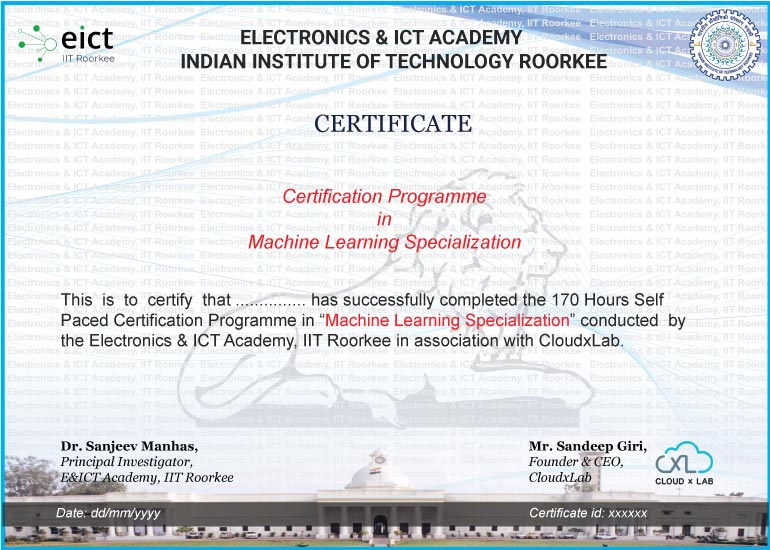
Certificate

What is the certificate like?

  • Why E&ICT, IIT Roorkee?

    The Electronics & ICT Academy program is sponsored by the Ministry of Electronics and Information Technology, Govt. of India. It conducts short courses/FDPs in the emerging areas to enrich & upgrade subject knowledge and technical skills benefiting faculty, working professionals and Govt. employees.

    The trained beneficiaries are expected to create a cascading effect, transforming the competencies and standards in the parent institutes/organizations. E&ICT courses are at par with QIP for recognition/credits. As of now the E&ICT Academy, IIT Roorkee has conducted 91 courses and trained over 5,000 beneficiaries.

  • Why Cloudxlab?

    CloudxLab (CxL) has been a pioneer in the edtech space for the past few years. Founded in 2015 by Sandeep Giri, an alumnus of IIT Roorkee, CxL has successfully transformed 1,000's of students' careers by offering world-class certification courses in big data, machine learning and artificial intelligence.

    Some of the unique features of CxL are an exclusive gamified learning environment through the lab (read as CloudxLab), highest rated faculty, excellent student support and more.


Hands-on Learning

hands-on lab
  • Gamified Learning Platform


  • Auto-assessment Tests


  • No Installation Required

Instructors

Instructor Sandeep Giri

Sandeep Giri

Founder at CloudxLab

Past: Amazon, InMobi, D.E.Shaw

Instructor Abhinav Singh

Abhinav Singh

Co-Founder at CloudxLab

Past: Byjus

Instructor Raksha Sharma

Raksha Sharma

Assistant Professor

IIT Roorkee

Instructor Gaurav Dixit

Gaurav Dixit

Assistant Professor

IIT Roorkee

Instructor Sanjeev Manhas

Sanjeev Manhas

Associate Professor

IIT Roorkee

Instructor R. Balasubramania

R. Balasubramanian

Professor

IIT Roorkee

Instructor Partha Pratim Roy

Partha Pratim Roy

Assistant Professor

IIT Roorkee

Instructor Jatin Shah

Jatin Shah

Ex-LinkedIn, Yahoo, Yale CS Ph.D., IITB

Course Advisor

Curriculum

170+
Hours of Training
240
Days of Lab Access
18+
Projects
15K+
Learners

1. Course on Python for Machine Learning

Topics
1. Introduction to Linux
2. Introduction to Python
3. Hands-on using Jupyter on CloudxLab
4. Overview of Linear Algebra
5. Introduction to NumPy & Pandas

2. Course on Machine Learning

1. Introduction to Statistics
1. Statistical Inference
2. Probability Distribution
3. Measures of Central Tendencies
4. Normal Distribution
2. Machine Learning Applications & Landscape
1. Introduction to Machine Learning
2. Machine Learning Application
3. Introduction to AI
4. Different types of Machine Learning - Supervised, Unsupervised
3. Building end-to-end Machine Learning Project
1. Machine Learning Projects Checklist
2. Get the data
3. Launch, monitor, and maintain the system
4. Explore the data to gain insights
5. Prepare the data for Machine Learning algorithms
6. Explore many different models and short-list the best ones
7. Fine-tune model
4. Classifications
1. Training a Binary classification
2. Multiclass,Multilabel and Multioutput Classification
3. Performance Measures
4. Confusion Matrix
5. Precision and Recall
6. Precision/Recall Tradeoff
7. The ROC Curve
5. Training Models
1. Linear Regression
2. Gradient Descent
3. Polynomial Regression
4. Learning Curves
5. Regularized Linear Models
5. Logistic Regression
6. Support Vector Machines
1. Linear Regression
2. Nonlinear SVM Classification
3. SVM Regression
7. Decision Trees
1. Training and Visualizing a Decision Tree
2. Making Predictions
3. Estimating Class Probabilities
4. The CART Training Algorithm
5. Gini Impurity or Entropy
6. Regularization Hyperparameters
7. Instability
8. Ensemble Learning and Random Forests
1. Voting Classifiers
2. Bagging and Pasting
3. Random Patches and Random Subspaces
4. Random Forests
5. Boosting and Stacking
9. Dimensionality Reduction
1. The Curse of Dimensionality
2. Main Approaches for Dimensionality Reduction
3. PCA
4. Kernel PCA
5. LLE
6. Other Dimensionality Reduction Techniques

3. Course on Deep Learning

1.Introduction to Artificial Neural Networks
1. From Biological to Artificial Neurons
2. Implementing MLPs using Keras with TensorFlow Backend
3. Fine-Tuning Neural Network Hyperparameters
2. Training Deep Neural Networks
1. The Vanishing / Exploding Gradients Problems
2. Reusing Pretrained Layers
3. Faster Optimizers
4. Avoiding Overfitting Through Regularization
5. Practical Guidelines to Train Deep Neural Networks
3. Custom Models and Training with Tensorflow
1. A Quick Tour of TensorFlow
2. Customizing Models and Training Algorithms
3. Tensorflow Functions and Graphs
4. Loading and Preprocessing Data with TensorFlow
1. Introduction to the Data API
2. TFRecord Format
3. Preprocessing the Input Features
4. TF Transform
5. The TensorFlow Datasets (TDFS) Projects
5. Convolutional Neural Networks
1. The Architecture of the Visual Cortex
2. Convolutional Layer
3. Pooling Layer
4. CNN Architectures
5. Classification with Keras
6. Transfer Learning with Keras
7. Object Detection
8. YOLO
6. Recurrent Neural Networks
1. Recurrent Neurons and Layers
2. Basic RNNs in TensorFlow
3. Training RNNs
4. Deep RNNs
5. Forecasting a Time Series
6. LSTM Cell
7. GRU Cell
7. Natural Language Processing
1. Introduction to Natural Language Processing
2. Creating a Quiz Using TextBlob
3. Finding Related Posts with scikit-learn
4. Generating Shakespearean Text Using Character RNN
5. Sentiment Analysis
6. Encoder-Decoder Network for Neural Machine Translation
7. Attention Mechanisms
8. Recent Innovations in Language Models
8. Autoencoders and GANs
1. Efficient Data Representations
2. Performing PCA with an Under Complete Linear Autoencoder
3. Stacked Autoencoders
4. Unsupervised Pre Training Using Stacked Autoencoders
5. Denoising Autoencoders
6. Sparse Autoencoders
7. Variational Autoencoders
8. Generative Adversarial Networks
9. Reinforcement Learning
1. Learning to Optimize Rewards
2. Policy Search
3. Introduction to OpenAI Gym
4. Neural Network Policies
5. Evaluating Actions: The Credit Assignment Problem
6. Policy Gradients
7. Markov Decision Processes
8. Temporal Difference Learning and Q-Learning
9. Deep Q-Learning Variants
10. The TF-Agents Library