Duration
Format
Projects
Certificate
Ratings
Learners
Computing systems have fueled the growth of AI. Improvements in deep-learning algorithms have inevitably gone hand-in-hand with the improvements in the hardware-accelerators. Our ability to train increasingly-complex AI models and achieve low-power, real-time inference depends on the capabilities of computing systems.
In recent years, the metrics used for optimizing and evaluating AI algorithms are diversifying: along with accuracy, there is increasing emphasis on the metrics such as energy efficiency and model size. Given this, researchers working on deep-learning can no longer afford to ignore the computing-system. Rather, the knowledge of potential and limitations of computing-system can provide invaluable guidance to them in designing the most efficient and accurate algorithms.
This course aims to inform students, practitioners and researchers in deep-learning algorithms about the potential and limitations of various processor architectures for accelerating the deep learning algorithms. At the same time, it seeks to motivate and even challenge the engineers and professionals in the architecture domain to optimize the processors according to the needs of deep-learning algorithms.
This course discusses AI acceleration on FPGAs, mobile GPUs, smartphones, ASICs (e.g., such as Google's TPU) and CPUs. It also discusses accelerators for recurrent neural networks and reliability issues/techniques for deep-learning algorithms/accelerators.
This course is at the intersection of deep learning algorithms and computer architecture, and chip-design, and thus, is expected to be beneficial for a broad range of audience.
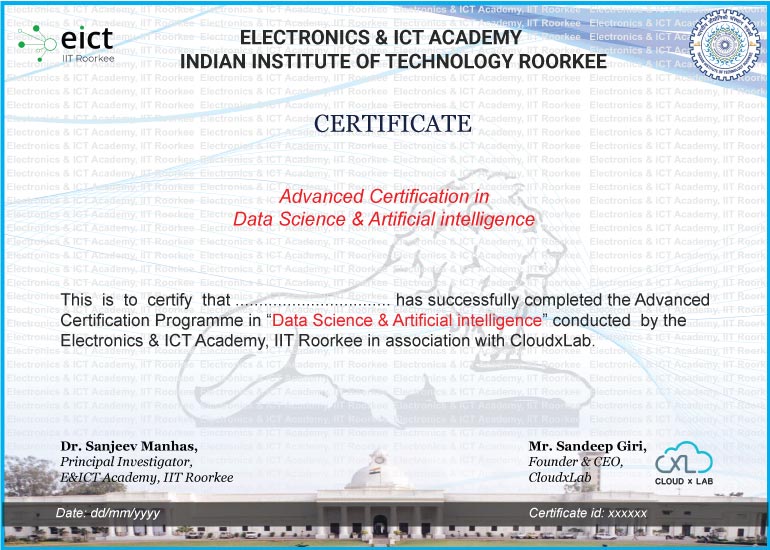
Upon successfully completing the course, you will get the certificate from IIT Roorkee which you can use for progressing in your career and finding better opportunities.














IIT Roorkee has been ranked the best among IITs, as per the QS World Best Universities Ranking 2019. Established in 1847, it's the oldest technical institutions in Asia.
IIT Roorkee fosters a very strong entrepreneurial culture. Some of their alumni are highly successful as entrepreneurs in the new age digital economy.
CloudxLab (CxL) has been a pioneer in the edtech space for the past few years. Founded in 2015 by Sandeep Giri, an alumnus of IIT Roorkee, CxL has successfully transformed 1,000's of students' careers by offering world-class certification courses in big data, machine learning and artificial intelligence.
Some of the unique features of CxL are an exclusive gamified learning environment through the lab (read as CloudxLab), highest rated faculty, excellent student support and more.








Churn the mail activity from various individuals in an open source project development team.
Solve various problems using MapReduce and Python.
Sentiment analysis of "Iron Man 3" movie using Hive and visualizing the sentiment data using BI tools such as Tableau.
Write end-to-end Spark application starting from writing code on your local machine to deploying to the cluster.
The logs of a webserver are the gold mines for gaining insights in the user behaviour. So learn to parse the text data stored in logs of a web server using the Apache Spark.
In this project we will build a machine learning model to predict housing prices. We will learn various data manipulation, visualization and cleaning techniques using various libraries of Python like Pandas, Scikit-Learn and Matplotlib.
The MNIST dataset is considered as "Hello World!" of Machine Learning. Write your first classification logic. Starting with Binary Classification learn Multiclass, Multilabel, Multi-output classification and different error analysis techniques.
Build a model that takes a noisy image as an input and outputs the clean image.
Build a model to classify email as spam or ham. First, download examples of spam and ham from Apache SpamAssassin’s public datasets and then train a model to classify email.
The sinking of the RMS Titanic is one of the most infamous shipwrecks in history. In this project, you build a model to predict which passengers survived the tragedy.
This project aims to impart the knowledge of how to access the pre-trained models from TensorFlow 2, and appreciate its powerful classification capacity by making the model predict the class of an input image.
Heroku is a cloud platform for the deployment and management purposes of web applications. You will learn how to deploy DeepLearning based Flask web app on Heroku.
We will train a KNN classifier to predict MNIST images from their noisy version.
Build a CNN from scratch to classify FashionMNIST data using Tensorflow2, Matplotlib and Python.
Learn how to deploy a machine learning model as a web application using the Flask framework.
Create a sentiment analysis model with the IMDB dataset using TensorFlow 2.
Learn how to read a pre-trained TensorFlow model for object detection using OpenCV.
Learn how to access the pre-trained models(here we get pre-trained ResNet model) from Keras of TensorFlow 2 to classify images.
Build a basic neural network to classify if a given image is of cat or not using transfer learning technique with Python and Keras.
Use TensorFlow 2 to generate an image that is an artistic blend of a content image and style image using Neural Style Transfer.
Learn how to over-sample the dataset with imbalanced classes using the SMOTE technique and how to use the thus obtained data to build a fraudulent transaction classifier.
As you know, the Google photos app has stunning automatic features like video making, panorama stitching, collage making, and many more. In this project, we will understand how to make a panorama stitching using OpenCV with Python.
Predict stock market closing prices for a firm using GRU, a state-of-art deep learning algorithm for sequential data, with Keras and Python.
Apply the idea of Transfer Learning to build an image classifier with Tensorflow2, and use it to predict the class of an input image - whether it is a cat or a non-cat.
Use Python and Numpy to build a Logistic Regression Classifier from scratch, and apply it to predict the class of an input image - whether it is a cat or a non-cat.
Use Python and Tensorflow 2 Keras to build a dense deep neural network classifier to predict the classes of flowers in the Iris dataset.
Build a model to classify clothes into various categories in Fashion MNIST dataset.
Identify person from digital image or video.
Project using OpenGym on Reinforcement Learning.
“Sessions were great, pace was also very good. Each of the steps were explained well multiple times to ensure everyone understands the concepts. Thanks Sandeep!”

“Thanks a lot,it was great course! I'm happy that you lead in this path to AI/ML/DL.I hope to continue to collaborate with you in future.”

“Thankyou so much Sandeep for all your great sessions. It will help in our career a lot. Your session is very much explanatory and understandable. Kudos to you.Thanks for all your hard work and time. Definitely, we will recommend all our friends and colleagues to attend your different course.Thanks a ton”

“I have been using CloudxLab for a while now, and they are amazing! The best part about using CloudxLab is that you do not need to wait for someone to tell you whether what you did was right or not, it is done automatically on the go. The training materials are of top notch quality. If you get stuck, they have a huge community of trainers and learners to help you out with all your doubts. They have a course structure for everyone, whether you are new to programming or are a seasoned programmer, they have something to offer you. And they are affordable too! I would recommend CloudxLab all the time.”

“This course is suitable for everyone. Me being a product manager had not done hands-on coding since quite some time. Python was completely new to me. However, Sandeep Giri gave us a crash course to Python and then introduced us to Machine Learning. Also, the CloudxLab’s environment was very useful to just log in and start practising coding and playing with things learnt. A good mix of theory and practical exercises and specifically the sequence of starting straight away with a project and then going deeper was a very good way of teaching. I would recommend this course to all.”

“It has been a wonderful learning experience with CXL. This is one of the courses that will probably stay with me for a significant amount of time. The platform provides a unique opportunity to try hands-on simultaneously with the coursework in an almost real-life coding example. Besides, learning to use algebra, tech system and Git is a good refresher for anyone planning to start or stay in technology. The course covers the depth and breadth of ML topics. I specifically like the MNIST example and the depth to which it goes in explaining each and every line of code. Would definitely recommend the instructor-led course.”

“This is one of the best-designed course, very informative and well paced. The killer feature of machine/deep learning coursed from CloudxLab is the live session with access to labs for hands-on practices! With that, it becomes easy following any discourse, even if one misses the live sessions(Read that as me!). Sandeep(course instructor) has loads of patience and his way of explaining things are just remarkable. I might have better comments to add here, once I learn more! Great Jobs guys!”

Senior Software Developer at Decision Resources Group